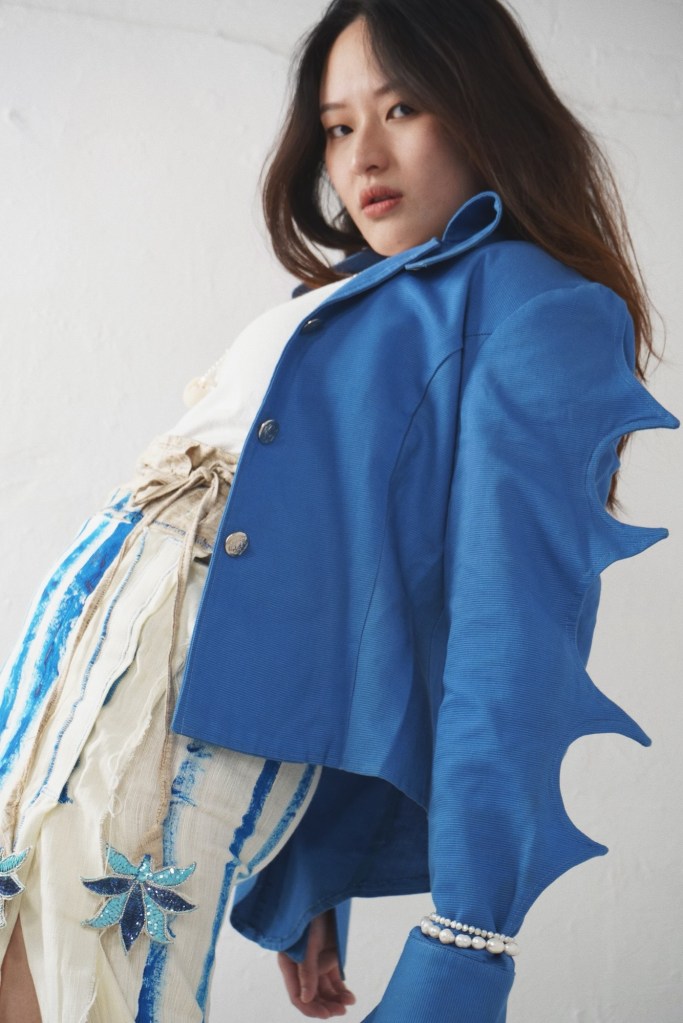
Styling: Reena Lakhani
Published in Croatian magazine Gloria, 21. IX. 2024.
Writer: Anela Martinović
Croatian designer presents digital dress collection in Helsinki, we spoke to her
Mandali Mendrilla reveals how her digital clothing collection, which she presented at Helsinki Fashion Week, was conceptualised, where she found inspiration and what attracts her to the fashion event.
Atelier Mendrilla, founded in 1995, enters a video game
and exhibits in a castle in the sky.
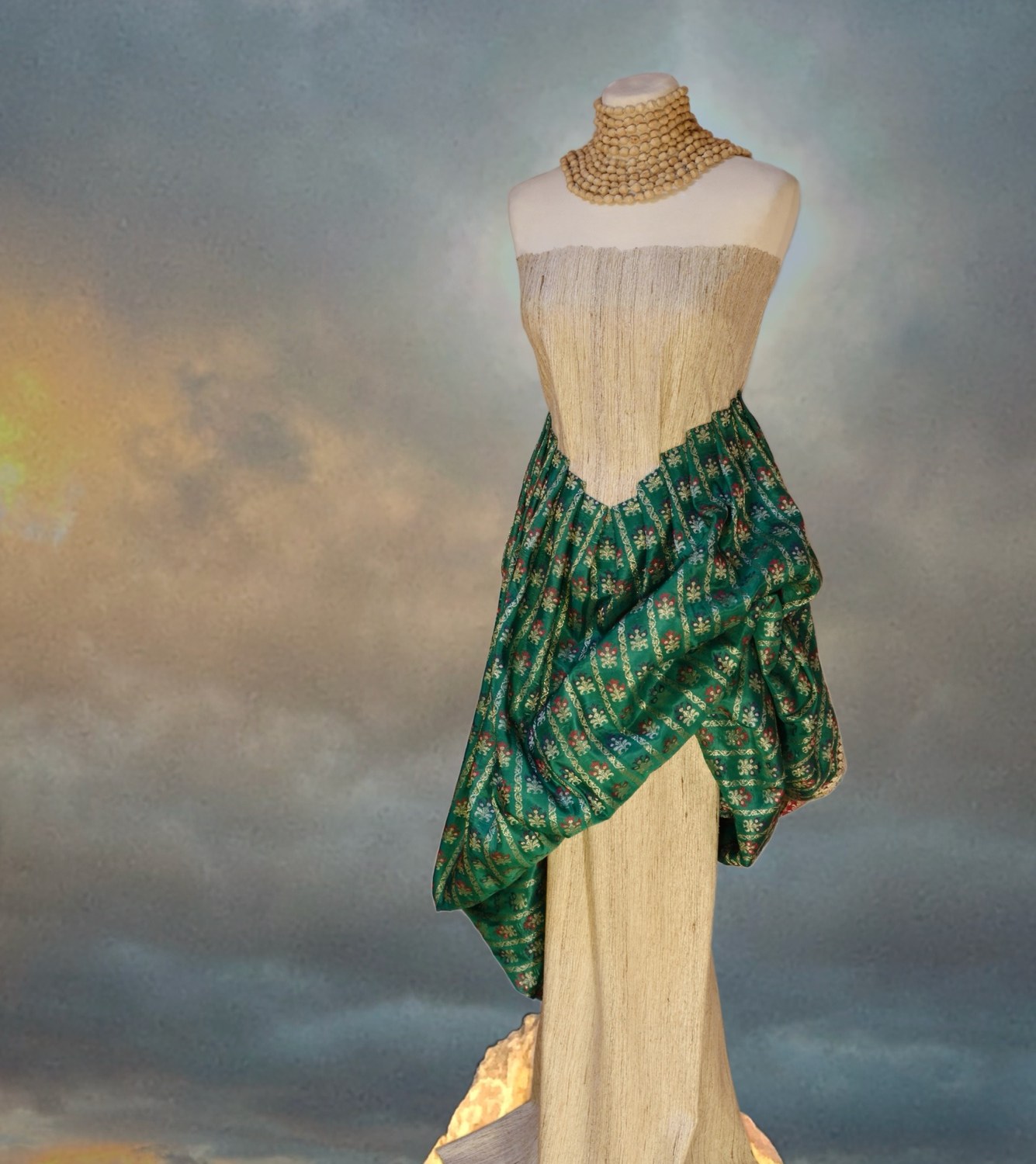
Designer Mandali Mendrilla (48) is the only Croatian fashion designer to participate in Helsinki Fashion Week. The Rijeka native who lives in the small town of D. in Luxembourg attended the fashion event for the third time this year, presenting a digital collection of dress sculptures created with her Yantra Couture method, in which she applies holistic principles: her creations are vegan, and in her creations she relies on principles of Eastern philosophy of harmony and peace.
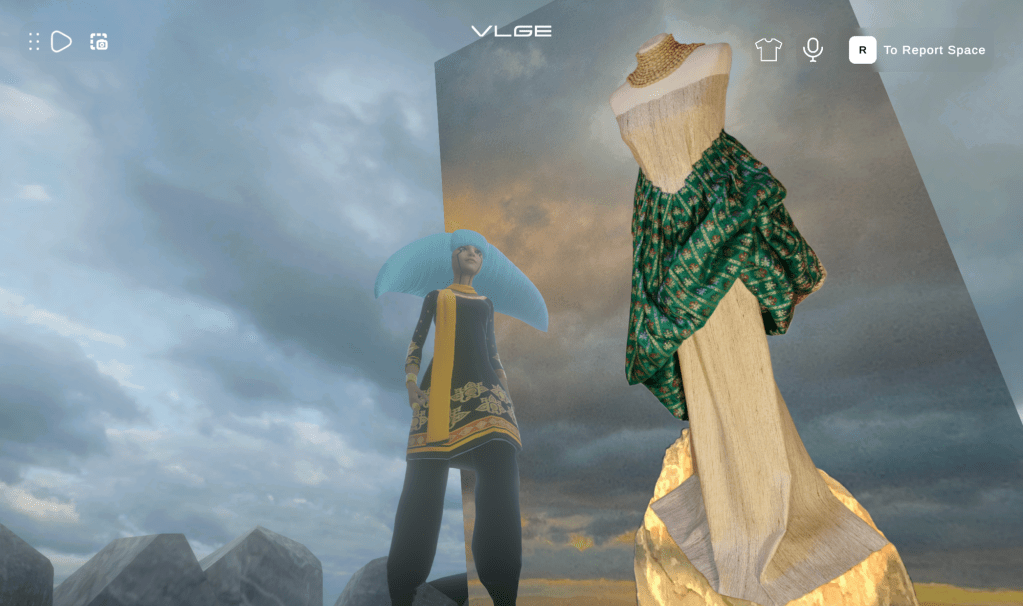
The dresses were presented in the form of a video game in which online Fashion Week visitors were invited to find portals leading to the exhibited objects. Mandali is also the author of several creations that have been exhibited in contemporary art museums in Madrid and Shanghai.
What is the “The Flower” collection that you presented at the Helsinki Fashion Week about?
– “The Flower” collection is an ode to the illusion of the fragility of eternal love, which looks like a delicate flower, but is powerful and eternal in nature. The collection completes the artistic triptych called “Time, Space & The Flower”, creations that were presented at different editions of Helsinki Fashion Week. The artistic fashion installation “The Flower” consists of sculptural dresses made of repurposed materials located in a refined digital universe. The exhibits were styled by London based stylist Reena Lakhani, and part of the composition and photography was executed with dutch photographer and my husband, Madhu Van Paare.

What inspired you to create them?
– Flowers that grow in my late mother Vesna’s garden and pictures of her flowers taken by my father Nenad. My mother’s love.
What is the video game about, who made it? Where can it be played?
– The video game was created by the VLGE.com platform, this year’s partner of Helsinki Fashion Week, and was playable during the event that took place at the end of August this year. Atelier Mendrilla experimented with applying the Yantra Couture method to attune and refine the digitally created world. What exactly this is about can be seen in the video on the Mandali Mendrilla YouTube channel or at mendrilla.com.
You mentioned the triptych “Time, Space & The Flower”. What is the idea behind it?
– Our work invites viewers to participate with their own interpretations. For me personally, it is an ode to the universe and the eternal love that permeates it, even though it is sometimes difficult to perceive.
Do you prefer digital or physical fashion?
– Both have value, but as a traditional designer who likes to feel the precious, sometimes sacred, materials that I use in my creations, I prefer physical fashion. The movements during traditional designing on a puppet are a form of yoga.
This is not the first time you have used modern technology. When and how did you start this type of creation?
– In the early 90s, while playing video games, I had a desire to create my own designs on the protagonists, but I did not follow it. This only came to fruition in 2020 when HFW went 3D, resulting in the fully digital Space collection in collaboration with Parisian studio Scotomalab and production house NDA Paris. The launch of the collection coincided with the departure of a long-time mentor whose advice gave me the confidence I needed to seriously continue building my own atelier – this was the world-renowned designer of Croatian origin, Goran Lelas. The Space collection was on the cover of the digital edition of Italian Vogue, of which Lelas was a long-time collaborator. I saw this as a wink.
How many times have you participated in Helsinki Fashion Week?
– This is the third time we have accepted the invitation to participate, especially since it marked the 10th anniversary edition of the sustainable event.
What are your impressions?
– I like that the event is completely focused on innovation and sustainability as well as animal protection. With each edition, they surprise more and more with new concepts, supporting young talents, and it is held once-a-year outside the classic seasons.
I believe in wearing quality pieces for many years, imaginatively mending torn items, wearing vintage pieces that are passed down from generation to generation (I even have clothes that belonged to my great-grandmother in my closet), that good design is beyond trends, that you can always innovate and learn, that animals should be protected and loved, that fashion can be art, and that we can all “sit together”… HFW is an event that supports and promotes such ideas, and I felt right at home.
Can you explain the concept behind Yantra Couture?
– Yantra is a type of sacred mandala or circular image. The Yantra Couture method is a secret of my atelier. It is based on a long-term study of ancient sciences about what is invisible to the eye, which in my experience greatly contributes to the quality and experience of a designed object.
How do you apply the principles of Indian philosophy in your creation?
– I have been studying Eastern philosophy since the early nineties and I still have a lot to learn… What I try to apply are the principles of non-violence, respect for all life, equality of all beings, the sanctity of the body as the temple of the soul, individualism and personalism in creation, sustainability…
You graduated from the Faculty of Philosophy in Rijeka. How and when did you start designing clothes? Where did you gain your knowledge?
– The journey of designing clothes began in the early nineties, at the summer retreat of the Rijeka Sušačka Gymnasium on Mali Lošinj, where we attended Krešimir Zimonić’s comic book drawing course and a clothing design course. There I drew my first fashion sketch and decided that clothing design was an intimate way for an artistic soul like mine to communicate with the world. I learned about fashion and art from my mother and selected tutors through private lessons, through friendships and socializing with respected mentors. I also learned through practice and passing on the knowledge I gained – and am still gaining – because I believe in lifelong learning, all over the world from America, England, Europe to India and China, while I chose literature as my main study in order to enrich myself through reading, gain more inspiration and improve my written expression.
What projects are you currently working on?
– Celebrating the 30th anniversary of Atelier Mendrilla, founded in 1995, and writing a book.

 "THE MANDALA"